The Ukrainian Greek Catholic Church — its identity and its history.
The Ukrainian Greek Catholic Church (UGCC) is the largest of the Eastern Catholic Churches sui juris. It is a Church of the Byzantine rite in full ecclesial communion with the Pope of Rome and a part of the worldwide Catholic Church, but it preserves its own liturgy, theology, spirituality, and discipline — the heritage of Kyivan Christianity.
The cathedral celebrates the Divine Liturgy and the sacraments according to this Eastern Byzantine tradition. Everything seen, heard, and done in the church — the icons, the incense, the chant — has one purpose: to lead us closer to God.
The Baptism of Rus. Prince Volodymyr the Great establishes Christianity in its Byzantine-Slavic rite as the religion of Kyivan-Rus — before the Great Schism of 1054. The Kyivan Church inherits the traditions of Constantinople yet remains in communion with Rome.
Union of Brest. The Synod of the Kyivan Church passes under the jurisdiction of the see of Rome while preserving its Eastern rite, liturgy, and customs. This marks the beginning of the Ukrainian Greek Catholic Church as an institution.
Repression under empire. As Russian power grows, Greek Catholics are pressured into forced "conversions" to Russian Orthodoxy. In western Ukraine under Austrian rule, the Hapsburgs protect and support the Greek Catholic hierarchy.
Sheptytsky era. Metropolitan Andrey Sheptytsky leads the Church through two world wars and seven changes of regime, making it an influential social institution in Western Ukraine.
The underground. The Soviet regime liquidates the Church — in Halychyna in 1946 and Transcarpathia in 1949. Priests are arrested and deported; communities survive only underground for over four decades.
Resurrection. The Church emerges from the underground in 1989. With Ukrainian independence in 1991, Cardinal Lubachivsky returns to Lviv and religious freedom opens a new chapter for all churches of Ukraine.
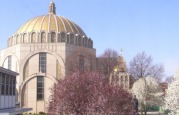 Ukrainian Catholic Cathedral